

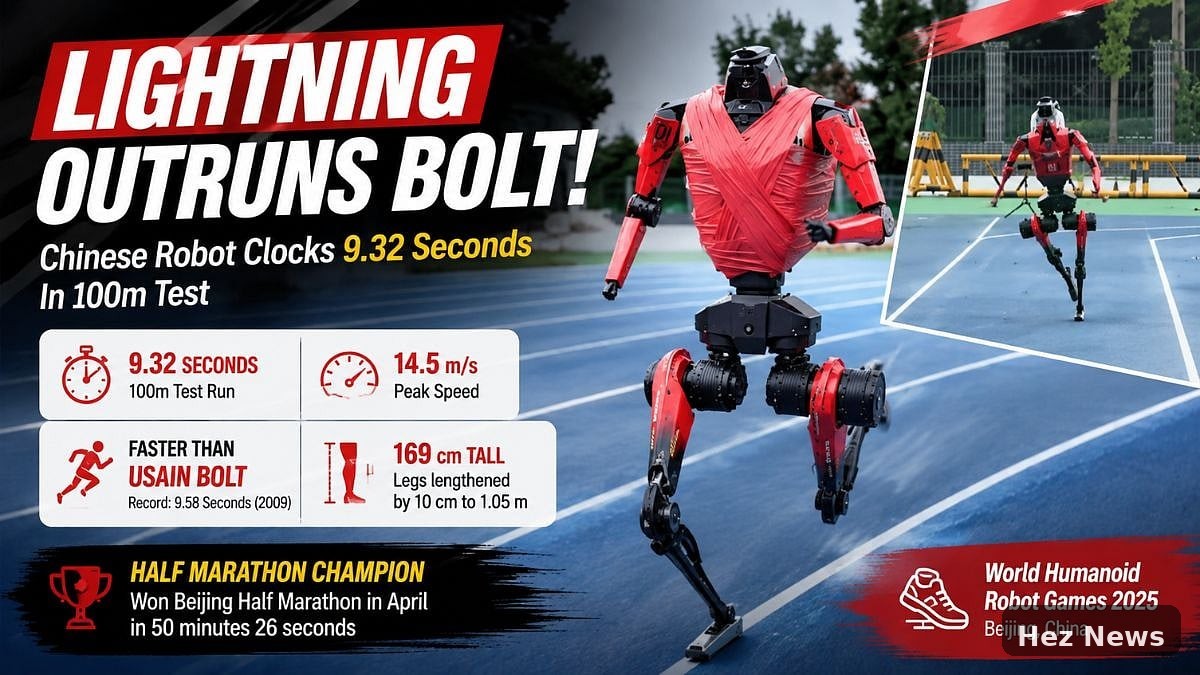
Beijing, August 22, 2026: A remarkable achievement has emerged from China as a humanoid robot, developed by the smartphone manufacturer Honor, has successfully completed a 100-meter dash in an astonishing 9.32 seconds. This new record surpasses the legendary Usain Bolt's previous world record of 9.58 seconds, marking a significant milestone in robotics and technology.
The Rise of Robotics in Sports
This breakthrough comes at a time when the intersection of technology and human capabilities is increasingly blurring. Humanoid robots are being developed not only for entertainment but also for practical applications in various fields, including sports. The robot's performance showcases the potential of robotics to mimic human athleticism, raising questions about the future of sports as we know it.
Usain Bolt's Legacy
Usain Bolt, a Jamaican sprinting icon, has held the 100m world record since 2009, a feat celebrated worldwide. His record was a testament to human potential, and many believed it would stand for decades. However, with advancements in technology, particularly in artificial intelligence and robotics, we are witnessing a shift in how records and achievements are perceived.
Implications for Nigeria
In Nigeria, where sports play a vital role in national identity and pride, this news could spark discussions about the future of athletics. Nigerian athletes have historically excelled in track and field, and the emergence of robotic competitors can lead to a re-evaluation of what it means to be a champion. Furthermore, this event highlights the importance of investing in technology and innovation, areas that Nigeria is gradually embracing.
Future Prospects
As the world watches this development, it is essential to consider the implications of robotics in various sectors. From enhancing training techniques for athletes to revolutionizing how sports are conducted, the future of athletics may involve more than just human competitors. This achievement by the humanoid robot could pave the way for further innovations that challenge our understanding of physical limits.
In conclusion, the feat of running 100 meters in 9.32 seconds not only sets a new benchmark in robotics but also opens up discussions about the future of sports, technology, and human achievement. As Nigeria continues to evolve in its technological landscape, it is crucial to stay abreast of such developments that could influence sports and beyond.





Leave a Comment