

Data and Information
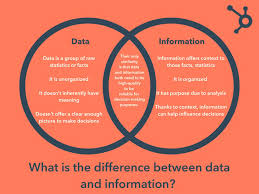
Data and information are two words usually used interchangeably.
However, no two words in English Language are the same, rather they may be nearest in meaning depending on the context clues. Data and information are facts, knowledge gained.
Data:
It is a raw fact or figure made up of numbers 0-9, letters A-Z, special characters, e.g. ?, }, *, %, #, etc.
Facts about the angular distance of a hall room, height of a building, age of a boy, etc. could also be a form of data.
Information:
Information means processed data or data that has been professionally manipulated. The result obtained from calculating the angular distance of a hall room is an information.
Difference between Data and Information
Data:
- It is organized.
- It is obtained through observation and recording.
- It is a raw input.
- It is presented in bits.
- It is the lowest level of knowledge.
Information:
- It is an organized result.
- It is a processed data.
- It is presented in whole.
- It is analyzed.
- It results from data manipulation.
- It is well presented.
Example of Data and Information
Data:
- Age of a boy
- No. of students in a class
- Diameter of a round table
- Height of a building, etc.
Information:
- Date of birth
- Total
- Circumference
- Average
- Area
Characteristics of Data:
- Completeness
- Accuracy
- Consistency
- Reliability
- Accessibility
- Timeliness
- Uniqueness
Completeness: Data is considered complete when all the data required for a particular use is present and available to be used.
Accuracy: The data must conform to actual, real-world scenarios and reflect real-world objects and events.
Consistency: Data consistency describes the data’s uniformity as it moves across channels and networks.
Reliability: If pieces of information doesn’t contradict another piece of information from a different source, that means you can’t trust the data.
Accessibility: It is how easily and quickly the required data available.
Timeliness: For data to retain its quality, it should be recorded promptly to manage changes.
Uniqueness: Data is unique if it appears only once in a data set.





Leave a Comment